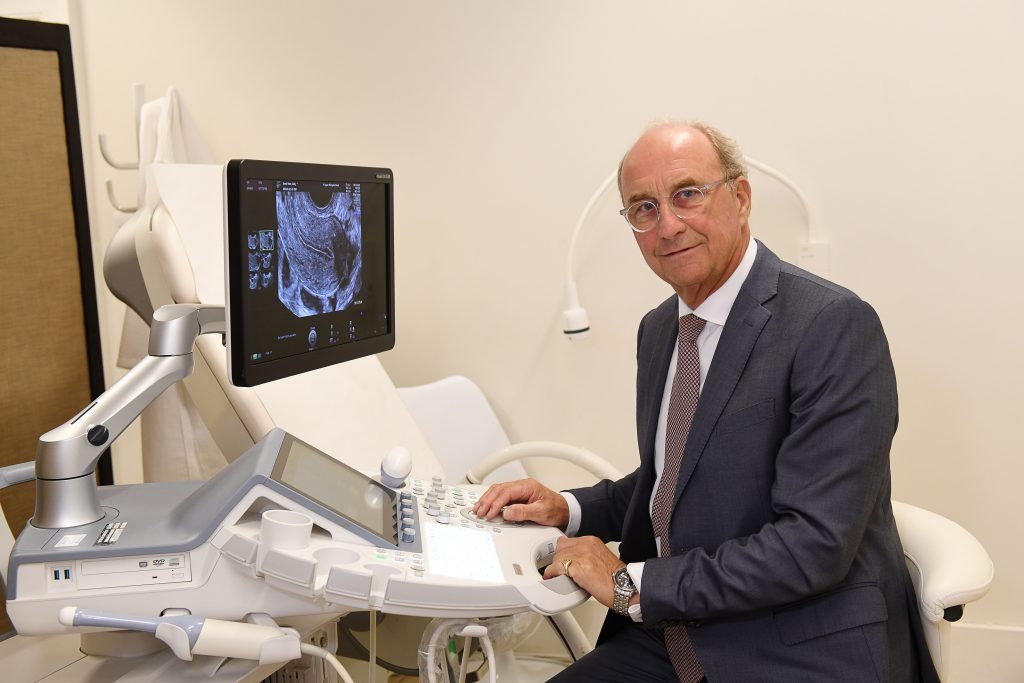
Mr Lower is a leading expert in minimal access gynaecological surgery. He has been at the forefront of a number of major advances in this field of medicine during the last 30 years. He was the first UK surgeon to use the Diomed Surgical LASER in the early 1990s and still uses this with great effect today. He has been a member of the Council of the British Society of Gynaecological Endoscopy and contributed a number of articles to learned journals. He is recognised as one of the two top Asherman’s Syndrome surgeons in the UK. He has been a pioneer of laparoscopic myomectomy and was an early adopter of the V-Loc barbed wound closure device which avoids the need for tying surgical knots in these procedures.
Minimal access gynaecological surgery includes both laparoscopic surgery and hysteroscopic surgery. At laparoscopy, a telescope of 5 or 10mm in diameter is introduced through the umbilicus or belly button, after the abdominal cavity has been filled with carbon dioxide gas to create space in which to operate. Two or three smaller incisions are made along the bikini line through which instruments are introduced with which the surgery is performed. At hysteroscopy, a smaller telescope of between 2 and 4mm in diameter is introduced into the uterine cavity (the inside of the womb) through the cervix or neck of the womb avoiding the need for any incisions on the abdomen at all.
Recovery from minimal access surgery is usually much faster than recovery from open surgery, and most women will go home on the day of surgery. The absence of a large incision on the abdomen allows the patient to mobilise more quickly and so reduces the incidence of some complications such as post-operative chest infections, wound infections, hernias and thrombosis. This also means a woman can return to work and normal activities much more quickly.
Mr Lower’s surgical practice has become more and more specialised in recent years and he now focuses solely on complex hysteroscopic surgery, for which he has an enviable reputation, treating intrauterine adhesions (Asherman’s syndrome), submucosal fibroids and uterine malformations such as uterine septum. He also offers surgical and medical management of miscarriage, ensuring that any operative procedures are performed under ultrasound control to minimise the risk of damage to the endometrium and subsequent adhesions.
His many years of experience allow him to assess other gynaecological conditions, arranging appropriate imaging and explaining the benefits and risks of surgery, with referral to carefully chosen, trusted colleagues for expert surgical management when required.